



A few years ago, I went with my two children to visit some of our family in the US.
Whilst we were there we took a road trip to see the Grand Canyon and Las Vegas.
Our trip was during the days between Christmas and New Year, the time of year that I always think is very slow after the lead up to Christmas Day and can remember in the early days of my bereavement that this was for me a bit of an emotional Canyon.
Our last approach into the Grand Canyon National Park was by train and as we approached there was lots of snow on the ground, which I hadn’t quite been expecting nor was the fact that we might not actually see the Grand Canyon itself. Sure enough ten minutes later when we walked to a view point, I couldn’t really see much but fog and snow. I knew there was this vast gaping hole there, but had no idea what it actually looked like, how wide this bit was, how deep it was, where the rocks and trees where. All we saw was a whiteness in front of us and knew it wasn’t a good idea to walk forward.
When we first lose someone, it can be like that emotionally and physically. There is this gaping, dangerous hole that you absolutely know is there, but its fogged over because of the emotional impact and also with the knowledge that it’s not quite the full picture. We can’t quite comprehend all that has happened.
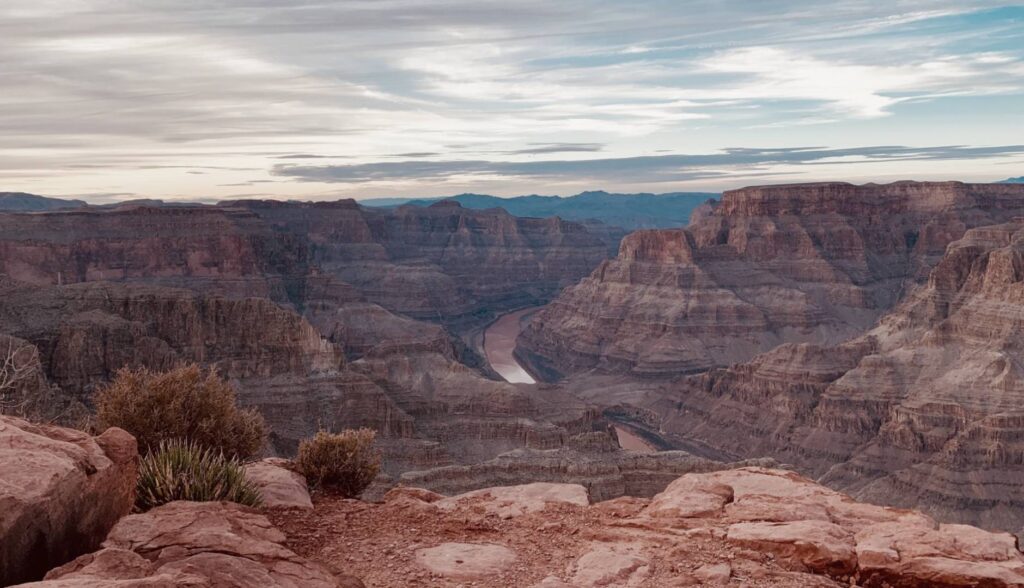
If that was all that I had seen of the Grand Canyon, after travelling all those miles, I would have felt cheated and left feeling very disappointed. Whilst we waited for the fog to clear, we went to an information centre and found out more about the Canyon, its formation and why over the years people have come there and how they have interacted with it. A couple of hours later, at sunset we went back to the rim of the Canyon. The fog had lifted and we saw layers of hazy colours in front of us. The crowds from the day had gone and it was silent, except for listening to my then twelve-year-old son throwing snowballs into the Canyon. First full view of the Canyon, it looked huge and moody in the fading light, but all together spectacular. Again, I was reminded that on part of my grief journey, as the fog lifts things can be a little hazy, some colour, some lack of clarity, still lots of danger and this can be a lonely part of the journey too.
We stayed over in a hotel on the National Park that night and visited the Canyon Rim again the following morning. It was a bright, crisp winter’s day and the sky was blue. We saw the snow tipped upper layers of the Canyon’s upper ridges in full view. The snow made them stand out even more and that was something very special to see. The snow on the Canyon was beautiful and actually made the ridges that had been caused by erosion and hard times over centuries to look even more spectacular
The man I married has been dead almost nine years and I can say that there are things of beauty and change that have gone on in me. There are painful deep ridges that have been cut in my life that although healed will always leave a scar. There are gaps in my children’s lives especially as they grow up without their dad and the impact that he would have had on their lives. However, we have a new understanding of grief and loss and what it’s like to lose a significant other and how we want to help other people in that situation.
As I looked down toward the many layers of the floor of the Canyon below, I saw walking trails on some of the ridges. It was too cold for most walking trips to operate that day, so didn’t see anyone down there, but I did think that if I was down there, how big/small would someone on the rim of the Canyon above look. In life, and especially in bereavement, we can walk a lonely path in our “valley of sorrow”. We need people on that rim to help us in whatever way that is. Practically, emotionally, regularly, spiritually. We need to look up and see who is on the rim for us to cheer us on. Sometimes those happen naturally, sometimes we need to proactively do something to get those people there – ask, search, step out to do that.


